How Can You Prevent Asymmetry and Nodules After Labia Majora Fat Grafting?
Why Does Tissue Volume Loss Occur in the Labia Majora, and What Are the Treatment Options?
The labia majora serve a critical anatomical function, acting as a protective cushion for the internal vulvovaginal structures against external friction, impact, and bacterial invasion. With aging, hormonal fluctuations (particularly estrogen decline during menopause), rapid weight loss, or childbirth, the subcutaneous fat pad within the labia majora undergoes progressive atrophy. This physiological regression leads to laxity, aesthetic concerns, and functional discomforts such as dryness, chronic irritation, and pain during physical activities. Labia majora remodeling is a specialized gynecological procedure designed to restore volume, symmetry, and protective function using autologous fat transfer or biocompatible dermal fillers.
While these procedures offer high patient satisfaction, achieving a natural result requires deep anatomical understanding. The vulva is highly vascularized, yet improper injection techniques can lead to compromised local circulation, tissue ischemia, and poor graft survival. Choosing the correct approach depends on individual anatomical laxity, the degree of volume deficit, and systemic health factors.
Treatment timing: Remodeling should be planned when localized tissue atrophy causes functional discomfort or visible structural asymmetry, provided there is no active pelvic infection or vulvar dermatitis.
Non-surgical care: Mild cases of dryness and minor tissue laxity can be managed conservatively with topical estrogen creams, pelvic floor physical therapy, and barrier-repair moisturizers before considering invasive volume replacement.
Treatment selection: The choice between autologous fat grafting and hyaluronic acid fillers depends on the patient’s individual tissue elasticity, systemic fat availability, tolerance for recovery downtime, and long-term volume retention goals.

How Do Fat Grafting and Dermal Fillers Compare in Labia Majora Restoration?
According to multiple observational studies and meta-analyses published in the Journal of Sexual Medicine (2021), clinical outcomes and complication rates vary significantly based on the chosen medium. Autologous fat transfer utilizing fat harvested from the abdomen or thighs provides a highly biocompatible, long-lasting solution, but its success depends heavily on the initial fat engraftment rate. On the other hand, specialized hyaluronic acid fillers offer a minimally invasive, immediate solution but require periodic maintenance.
| Comparison Factor | Autologous Fat Transfer | Hyaluronic Acid (HA) Filler |
|---|---|---|
| Primary Benefit | Semi-permanent retention once successfully engrafted; completely natural tissue integration. | Immediate results with minimal downtime and no donor-site morbidity. |
| Key Limitation | Variable initial retention rates (typically 40% to 60%); requires a donor harvesting procedure. | Temporary duration (typically 12 to 18 months); higher material cost for large volumes. |
| Nodule Risk (Clumping) | Moderate if fat is injected in large boluses, leading to focal liponecrosis. | Low to moderate if highly cohesive filler is placed too superficially. |
| Recovery Period | 1 to 2 weeks for swelling and bruising to subside at both donor and recipient sites. | Minimal swelling resolving within 3 to 5 days. |
According to official guidelines from international societies of aesthetic plastic surgery, maintaining structural symmetry in vulvar remodeling requires not only precise volumetric calculation but also meticulous evaluation of underlying tissue compliance and pelvic vascular health.
What Causes Postoperative Asymmetry, Nodules, and Poor Fat Engraftment?
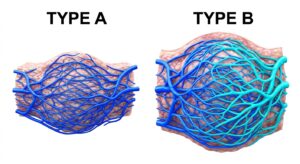
Postoperative complications such as nodules (clumping) and asymmetry are primarily technical rather than physiological. When autologous fat is harvested, processed, and reinjected, the survival of the transferred adipocytes depends entirely on the diffusion of oxygen and nutrients from the surrounding recipient capillary bed. This process of tissue vascularization takes several days. If a large volume of fat is deposited in a single layer (bolus injection), the center of the fat mass remains isolated from blood flow, leading to ischemic cell death, or liponecrosis. Over time, these necrotic areas trigger an inflammatory response, leading to calcification and the formation of hard, palpable liponecrotic nodules.
Furthermore, structural asymmetry often arises from a failure to account for pre-existing anatomical discrepancies. No human body is perfectly symmetrical, and the labia majora are no exception. Injecting identical volumes of fat or filler into both sides without evaluating baseline tissue compliance and volume deficits will inevitably result in visible asymmetry. Additionally, excessive physical friction, premature pressure on the treated area, or inadequate postoperative immobilization during the critical 14-day engraftment phase can displace the injected material, compounding the risk of asymmetry and clumping.
However, outcomes may differ in exceptional cases such as patients with severe pre-existing systemic vascular disease, heavy smokers, or those with uncontrolled diabetes, where compromised microcirculation drastically lowers the baseline fat engraftment rate regardless of surgical technique.
How Can Patients and Surgeons Mitigate the Risks of Complications?
Minimizing adverse effects requires a combined approach of meticulous surgical execution and strict adherence to postoperative recovery guidelines. Surgeons must utilize a multi-level, multi-tunneling technique, dispersing micro-droplets of fat across different anatomical planes—such as the deep subcutaneous layer and superficial subdermal interface—to maximize contact with vascularized tissue. To guide patients through this clinical pathway, the following structured decision-making protocol is recommended.
Structural Decision-Making Flowchart
- Step 1 (Assessment): Evaluate the patient’s baseline tissue elasticity and determine if the primary concern is structural asymmetry, skin laxity, or a generalized volume deficit.
- Step 2 (Selection): If the patient has adequate donor sites and seeks a permanent solution, proceed with autologous fat transfer using micro-cannulas; if rapid recovery with zero donor morbidity is preferred, opt for highly cohesive hyaluronic acid fillers.
- Step 3 (Post-Op Care): Ensure complete avoidance of local pressure, strenuous lower-body exercise, and sexual activity for a minimum of 3 to 4 weeks to stabilize the injected matrix.
- Micro-grafting technique: Injecting fat in volume fractions smaller than 0.1 cc per pass to ensure immediate exposure to host capillary networks.
- Aseptic processing: Utilizing closed-system centrifuges or filtration kits to minimize adipocyte trauma and reduce contamination risks.
- Donor site optimization: Harvesting fat from high-viability zones such as the medial thigh under low-vacuum pressure to preserve cell membrane integrity.
- Postoperative pressure avoidance: Refraining from tight clothing, bicycling, or prolonged sitting directly on the vulvar region during the initial 3 weeks.
- Controlled thermal environment: Avoiding direct heat packs or hot baths on the treated area, as high temperatures can accelerate fat cell degradation before vascularization is established.
Frequently Asked Questions FAQ
QWhy do lumps or nodules form after labia majora fat grafting?
Nodules, or clumps, typically form due to localized fat necrosis. If too much fat is injected into a single tissue plane, the central adipocytes fail to receive adequate blood flow and oxygen. This leads to cell death, localized inflammation, and the subsequent formation of fibrous scar tissue or calcified cysts, which feel like hard lumps.
QHow long does it take for the final volume and symmetry to stabilize?
The initial swelling and bruising subside within 1 to 2 weeks, but the biological process of fat engraftment and tissue remodeling takes approximately 3 months. Around 12 weeks post-procedure, the surviving fat cells establish a permanent blood supply, and the final shape, volume, and symmetry of the labia majora can be accurately assessed.
QWhat can be done if asymmetry is detected during the recovery phase?
Minor asymmetry during the first 4 to 6 weeks is highly common due to uneven swelling and localized fluid retention. If persistent structural asymmetry remains after 3 months, it can be safely corrected through a minor secondary micro-fat graft or target-specific hyaluronic acid filler refinement once the tissues have completely healed.

This content is general medical information, and individual treatment decisions should be made through imaging tests and in-person medical evaluation.
Author: Medical content editor based on medical information research
Reviewed by: Specialist consultation from the relevant department
Last reviewed: 2026-07-21
Reference guideline: 2022 Aesthetic Surgery Journal Clinical Consensus Guidelines on Female Genital Cosmetic Surgery
Medical neutrality and closing note
The core of medical decision-making is not to follow a specific device or a trending procedure, but to choose an option that fits each patient’s individual anatomy, condition, risk level, and treatment goals. Every procedure has both advantages and limitations, so decisions should be made after sufficient discussion with an experienced specialist.
[Medical information and copyright notice]
This content is a professional medical column prepared based on medical consultation from 다움산부인과.
The infographics used in this article are created to support understanding and may differ from actual clinical results.
The information provided is a general medical guideline, and accurate diagnosis and treatment require an in-person evaluation by a qualified specialist.